You wrote your review, pressed submit — and now what? Most reviews go live quickly, but every single one travels the same pipeline first, and understanding that pipeline saves you the "where did my review go?" worry. This article follows a review from submission to publication and beyond: the automated checks, the reasons a review might pause for a human look, and what happens after it is live.
The short version: your review is checked by TrustGuard, our automated integrity system, the moment you submit it. Clean reviews from established, email-verified accounts publish automatically. Reviews that trip a check — or that are simply the first review from a new account — wait for a human moderator. Nothing is silently discarded.
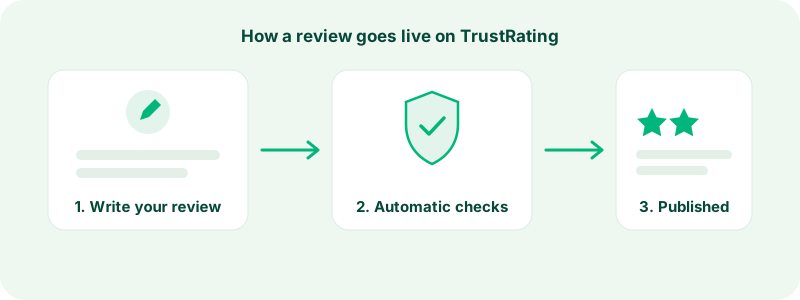
Step 1: Your review is submitted
When you press submit, the review is saved immediately with a pending status. You are redirected back to the company page with a banner telling you what happened: either your review is already published, or it is pending checks, or — if you posted as a guest — it is waiting for you to confirm your email address. Your review is never lost between these states; you can always see your reviews and their current status from your account.
If you submitted without being logged in, one step is entirely in your hands: click the confirmation link we emailed you. A guest review cannot publish until the email is verified, no matter how clean it is — the confirmation is what proves the review really came from you. If the email has not arrived, check spam before anything else.
Step 2: TrustGuard runs its automated checks
Within moments of submission, TrustGuard analyzes the review. It is the same system described in how we fight fake reviews, and it examines many signals at once. We keep the exact mechanics private on purpose — publishing them would hand fraudsters a manual — but the categories are no secret:
- Account signals. How established is the reviewing account? Is the email address from a throwaway domain? Does the account have a history of removed or flagged reviews?
- Behavioral signals. Is this account posting reviews unusually fast? Are many reviews suddenly landing on the same company in a short window — the fingerprint of a coordinated campaign?
- Content signals. Is the text a duplicate of another review, on this company or elsewhere? Does it contain spam patterns, promotional content, or mentions of being rewarded for the review? Does the star rating contradict what the text actually says?
- Network signals. Are multiple "different" reviewers submitting from the same connection or device?
- Authenticity analysis. When other signals raise suspicion, an additional AI-assisted check evaluates whether the text reads like a genuine first-hand account.
Each signal contributes to an overall risk assessment. Genuine reviews from real customers rarely trip anything at all — these checks are tuned to catch patterns that honest reviewing simply does not produce.
Credibility works in your favor too. A review tied to a verified purchase, an email-verified account, or a reviewer with a long clean history gets the benefit of the doubt, because those are exactly the things fake-review operations struggle to fake.
Step 3: Published — or held for a human
Three outcomes are possible:
- Published automatically. The review passed every check and the author's email is verified. It appears on the company page and starts counting toward the TrustScore right away.
- Held for moderation. Something needs a human look. The review stays pending — visible to you, not yet to the public — until a moderator reviews it.
- Flagged. Strong suspicion routes the review into a priority moderation queue. This does not mean it is fake; it means a person, not an algorithm, will make the call.
Why your review might be held
A hold is not an accusation. The most common reasons are mundane:
- It is your first review. The very first review from any account gets a human look before going live, unless it came through a verified purchase invitation. This single rule blocks an enormous amount of fraud — throwaway accounts never get a free first shot — and it means your first-ever review may take longer than every review you write afterwards.
- You posted as a guest and have not confirmed your email yet. The review is waiting on you, not on us.
- Unusual timing or patterns. If the company is receiving a burst of reviews, or your account posted several in quick succession, reviews may pause while the pattern is assessed.
- Something in the text tripped a check. Duplicated text, promotional content, or a rating that contradicts the review body all invite scrutiny.
Tip: The single best way to skip holds entirely is to review through invitation links when you receive them, and to keep your email verified. Verified purchases are exempt from the first-review hold altogether.
How long does moderation take?
Automated checks finish in seconds. Human moderation depends on queue volume, so we do not promise a fixed turnaround — most held reviews are resolved promptly, and held reviews are also re-evaluated automatically over time. Time-based signals age out: an account that was brand new at submission stops being new, and a review held only for cautionary reasons can clear on its own without a moderator touching it.
If your review has been pending for what feels like an unreasonably long time, contact support with the company name and roughly when you submitted.
When your review publishes
Once published, several things happen at once. The review appears on the company profile and your reviewer profile. It starts counting toward the company's TrustScore. The business is notified that a new review arrived, and users who follow the company see it in their feeds. From this point the review is part of the public record.
Company replies. Businesses can respond publicly under your review, and you will receive a notification the first time they do. A reply does not change your rating or your review — it sits below it, visible to everyone. Many disputes get resolved through exactly this channel, and if the company makes things right, you can update your review to reflect it.
Being flagged after publication
Publication is not immunity. Anyone with an account can report a published review they believe violates the guidelines, and businesses have their own reporting channel. A single report does not hide anything — it simply asks moderators to look. But when several independent users report the same review, it is temporarily pulled back into the moderation queue while a human investigates.
If a moderator takes action on your published review — hides it or flags it for deeper review — you receive a notification explaining what happened. Reviews are only removed for guideline violations: fake content, conflicts of interest, personal data, abuse, promotion. A review is never removed just for being negative, and companies cannot pay to make criticism disappear.
Moderation decisions and appeals
Moderators are human, and humans occasionally get it wrong. If your review was hidden or removed and you believe the decision was mistaken, contact support from the account that wrote the review. Explain the situation and include anything that supports your case — an order confirmation or receipt is the strongest evidence that your experience was genuine. Appeals are reviewed by a person, and decisions can be and are reversed when the evidence supports it.
Quick answers
"My review disappeared after being visible." It was most likely reported and is being re-checked, or a moderator acted on it. Check your notifications; if there is nothing there, contact support.
"The company replied — do I have to respond?" No. But if they resolved your problem, updating your review and rating helps the next reader see the full story.
"Can the company see who reported their review?" No. Reports are confidential; see reporting a review.
"Does an edited review go through checks again?" Yes — editing sends the review back through moderation. Details in editing or deleting your review.