Every company profile on TrustRating displays a TrustScore — a number from 1.0 to 5.0 shown beside the star rating. It is the single most-cited figure on the platform, so it is worth understanding exactly what goes into it, why it sometimes differs from the plain average of the stars, and what it means for both shoppers and businesses.
Why not just average the stars?
Imagine two companies. Company A collected thirty five-star reviews in 2021 and nothing since. Company B has four hundred reviews averaging 4.4, including dozens from the last month. A naive average would rank Company A higher — yet almost everyone would rather buy from Company B today. A plain average has three blind spots:
- It ignores time. Businesses change. Ownership changes, support teams change, product quality changes. A review from three years ago says little about the company you would deal with tomorrow.
- It ignores volume. Five perfect reviews are statistically fragile; five hundred good ones are a track record. Small samples are also far easier to manipulate.
- It invites gaming. If old reviews counted forever at full weight, a company could burst-collect positive reviews once and ignore customers afterwards.
The TrustScore is designed to close those gaps.
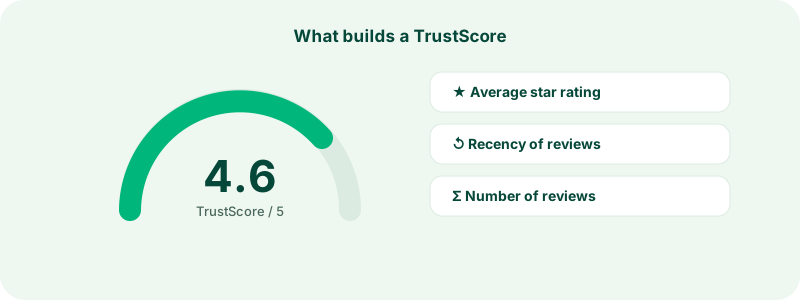
The three ingredients
Star ratings. The foundation is still what reviewers actually say. Each published review contributes its one-to-five star rating. Reviews that were removed for violating guidelines never count, and reviews held by our integrity systems do not count until they are published.
Recency. Newer reviews carry more weight than older ones. The influence of a review gently decays over time — it never disappears entirely, but a rating from last month says more about the company today than one from three years ago, and the score reflects that. This is why you will sometimes see a company's TrustScore drift downward even without new negative reviews: its glowing feedback is simply aging.
Volume. The score is stabilized so that a company with very few reviews cannot instantly reach the extremes. Early on, each review moves the score noticeably; as the review base grows, the score becomes steadier and more trustworthy. This protects small businesses from being destroyed by one unfair rating, and it stops brand-new profiles from sporting a perfect 5.0 off the back of two reviews from friends.
The precise formula is published openly on our methodology page — we believe a trust metric only deserves trust if you can see how it works.
What the ranges mean
As a rough reading guide:
- 4.3 and above — excellent. Consistently strong feedback, kept current.
- 3.8 to 4.2 — good. Most customers are satisfied; read recent reviews for specifics.
- 3.0 to 3.7 — mixed. Real strengths and real problems; the written reviews matter most here.
- Below 3.0 — poor. A pattern of unhappy customers. Look for how (and whether) the company responds.
Always pair the number with a scan of recent reviews and the company's replies. A 3.9 where the business answers every complaint thoughtfully can be a better bet than a silent 4.4.
What businesses can and cannot do about their score
Companies claiming their profile often ask how to improve their TrustScore. The honest answer is the design goal of the whole system: serve customers well, and ask them to share it.
What genuinely works:
- Invite every customer to review, not just the happy ones. Invited reviews come from verified purchases, arrive steadily, and keep your score fresh. See sending review invitations.
- Reply to reviews, especially critical ones. Replies do not change the score directly, but they change reader perception and often lead reviewers to update their rating after a problem is resolved.
- Fix the root causes your reviews point at. The analytics tools surface recurring topics — see reading your analytics.
What does not work:
- Buying or faking reviews. TrustGuard screens every review for fraud signals, and fake-review patterns are exactly what it is tuned to catch. Companies caught soliciting fake reviews face enforcement up to profile labeling and removal from rankings.
- Paying to hide criticism. No plan, at any price, removes legitimate negative reviews. Moderation applies the same published guidelines to everyone.
- Reporting reviews just for being negative. Flags are for guideline violations. Abusing the reporting system is itself a violation.
Common questions
"A review was just published — why didn't the score move?" With a large review base, one review moves the score by design only slightly. The math is working as intended.
"Why does a competitor with fewer reviews have a higher score?" Volume stabilizes rather than caps the score. A smaller company with uniformly excellent recent reviews can legitimately outrank a bigger one with mixed feedback.
"Do verified purchases count more?" Verified reviews are weighted the same in the score itself, but they are far less likely to be held or removed by integrity screening — so in practice, a verified review base is a more durable one.
"Can the score be manually adjusted?" No. Scores are computed from reviews by the published formula. Not even TrustRating staff can set a company's score by hand.
"How quickly does the score update?" Effectively immediately. When a review is published, edited, or removed, the company's score is recomputed and the new value appears on the profile, in search results, and in any embedded widgets on the company's own website. There is no nightly batch or manual refresh — what you see is always calculated from the current set of published reviews.
"Does flagging a review change the score?" Not by itself. A flagged review keeps counting while moderators investigate; it only leaves the calculation if the investigation ends in removal. This prevents the reporting system from being abused as a score-manipulation tool — a company cannot dent a competitor, and a competitor cannot dent them, just by filing reports.
Digging deeper
If you want the complete picture of how reviews travel from submission to publication — including the automated checks along the way — read what happens after you submit a review. For the philosophy behind our approach to review integrity, our trust in reviews page is the definitive statement.