Fake reviews are not a nuisance for a review platform — they are an existential threat. A platform that cannot tell genuine customers from paid shills is worse than useless: it actively misleads people at the exact moment they are trying to make a careful decision, and it punishes honest businesses by letting dishonest competitors buy a better reputation. Every part of TrustRating's value rests on one promise: the reviews you read reflect real experiences from real people.
This article explains, layer by layer, how we keep that promise. We are deliberately open about how the system is structured and deliberately quiet about the exact tripwires inside it. Publishing precise detection rules would hand fraudsters a manual for evading them. So you will find qualitative descriptions here and in our public methodology — never exact scores, thresholds, or rule details.
Why this problem never goes away
There is real money in fake reviews. A star rating influences purchase decisions, so a market exists for manufactured reputations: businesses buying praise for themselves, businesses buying attacks on competitors, and professional sellers running account networks to supply both. The attackers adapt, and many now use AI tools to write fluent-sounding reviews.
That is why no single defense is enough: account checks alone are beaten by patient fraudsters who age their accounts, and text analysis alone misses coordinated campaigns of plausible-sounding reviews. TrustRating's answer is depth — several independent layers, each catching what the others miss.
Layer one: real accounts with verified email
Every review on TrustRating is tied to a registered account, never to an anonymous drive-by post. Email verification is part of the pipeline: a review from an unverified address does not go live until the author confirms their inbox. That single click is a surprisingly effective filter — throwaway bot accounts rarely bother, and accounts registered with disposable email domains are detected and treated as a risk signal from the start.
Layer two: bot protection at every door
Automated fraud starts with automated signups. TrustRating uses a privacy-friendly human-verification challenge (Cloudflare Turnstile) at the points bots need to pass: creating an account, signing in, and submitting a review. Real people almost never see more than a quick checkbox; scripted account farms hit a wall before they can post anything at all.
Layer three: TrustGuard screens every review
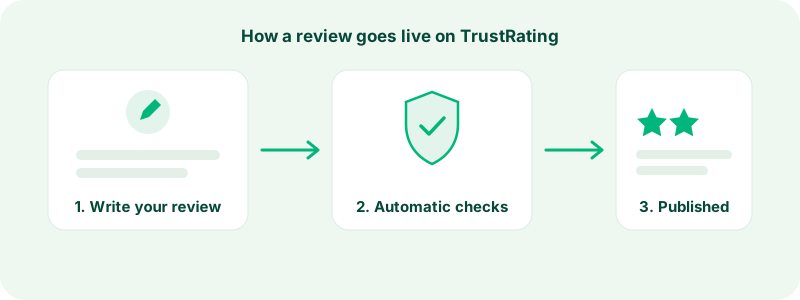
The heart of the system is TrustGuard, our automated fraud-detection engine. Every submitted review — every single one — is analyzed before or immediately after it would go live. TrustGuard looks at many signal types at once, including:
- Account behavior. Brand-new accounts, bursts of many reviews from one author in a short window, and authors with a history of removed reviews all raise scrutiny.
- Coordinated patterns. Many reviews landing on one company in a short period, or multiple reviews arriving from the same network address or device fingerprint, look like a campaign rather than a coincidence.
- Text fingerprints. Duplicate or near-template text — the same review body pasted onto one company by different accounts, or pasted by one author across many companies — is classic fake-review spam.
- Suspicious content. Language suggesting an incentivized review ("free product in exchange for…"), spam patterns, signs of AI-generated text, and reviews whose written tone contradicts their star rating.
No single weak signal condemns a review; genuine customers occasionally trip one by accident. But signals stack, and a review that accumulates enough risk is held for a human instead of being published. Credibility works in the other direction too: reviews from verified purchases, verified email addresses, and reviewers with a long clean history get the benefit of the doubt. TrustGuard also re-evaluates held reviews over time, so a review held only because the account was minutes old can clear on its own once the picture improves.
Layer four: first reviews get extra scrutiny
The very first review from a new account is the most common vehicle for fakes, so it receives special treatment: it is checked by a human moderator before going live rather than published automatically, even when nothing else looks suspicious. The exception is a review written through a verified purchase invitation — an invitation from a real transaction is strong evidence of authenticity, so those publish through the normal flow. If your first review takes a little longer to appear than you expected, this is almost always why. Our guide to what happens after you submit walks through the timeline.
Layer five: human moderators make the final call
Automation flags; people decide. Reviews held by TrustGuard go to a moderation queue where a human reviews the evidence and makes the call: publish, or remove. Moderators apply the published guidelines — not gut feeling, and not the commercial interests of anyone involved. When a review is removed or held, its author is notified and told how to dispute the decision, so enforcement never happens silently.
Layer six: the community keeps watch
No screening system is perfect, so publication is not the end of scrutiny. Every published review carries a report option: if you spot something that looks fake, abusive, or off-topic, you can flag it and a moderator will investigate. Multiple independent reports from different people escalate a review automatically. Businesses can also report reviews on their own profile through their business account. The full process is covered in reporting a review or a company.
Everyone plays by the same rules
Businesses cannot pay to remove reviews. No plan, at any price, deletes legitimate criticism, boosts a TrustScore, or buys lenient moderation. Paying customers and free profiles face identical guidelines, identical screening, and identical enforcement. A trust platform that sold exceptions would have nothing left to sell.
Consequences for fraud
Fake reviews carry real consequences on both sides of the transaction:
- For fake-review authors and sellers. Fraudulent reviews are removed, and the accounts behind them face suspension. Because reviewer history is itself a risk signal, a burned account poisons everything else it ever posted — networks of fake accounts tend to unravel together once one thread is pulled.
- For businesses that buy them. Companies caught soliciting or purchasing fake reviews face escalating penalties: losing access to review invitations, having new reviews disabled, public suspension notices on their profile, and in serious cases full delisting from search and rankings. A company profile is a privilege conditioned on honest participation.
What you can do as a reader
You are a layer of defense too. A few habits make you very hard to fool:
- Look for the Verified purchase badge. It means the review came through a confirmed transaction — the strongest authenticity signal we have.
- Read the company's replies. How a business handles criticism tells you more than any single review. See replying to reviews for how that works.
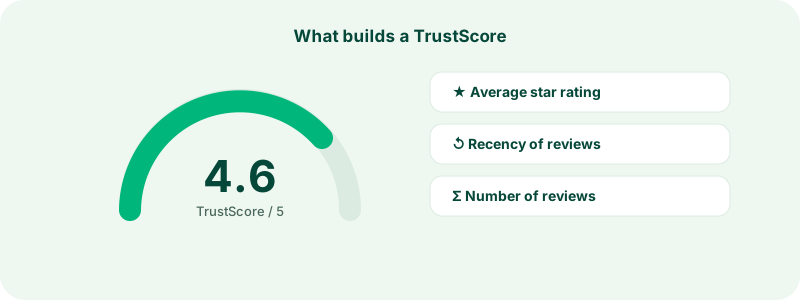
- Weigh the whole picture. The TrustScore blends rating, recency, and volume precisely so that a burst of suspicious praise cannot dominate it.
- Report what looks wrong. Your flags feed directly into the moderation queue.
Common questions
"Why won't you publish the exact detection rules?" Because the audience that would benefit most is fraudsters. We publish the structure and the principles — the methodology and trust in reviews pages go as deep as we responsibly can.
"Does a held review mean I'm accused of something?" No. Holds are routine, especially for first reviews, and most held reviews are published after a check.
"Can a company get my honest review removed by reporting it?" Not for being negative. Reports trigger investigation against the guidelines; a genuine, on-topic experience stays up.
If you ever spot something our layers missed, report it — it genuinely helps.