The TrustRating affiliate program pays you for spreading the word. You recommend TrustRating to businesses that could benefit from collecting and showcasing customer reviews, they sign up through your personal referral link, and when they subscribe to a paid plan you earn a commission on what they pay. This guide covers everything up to your first referral: what the program actually is, who it works best for, how to apply, how applications are reviewed, and what to expect once you are in.
If you are already an affiliate and want to understand how commissions mature and how to withdraw your earnings, jump straight to tracking earnings and payouts.
What the program is
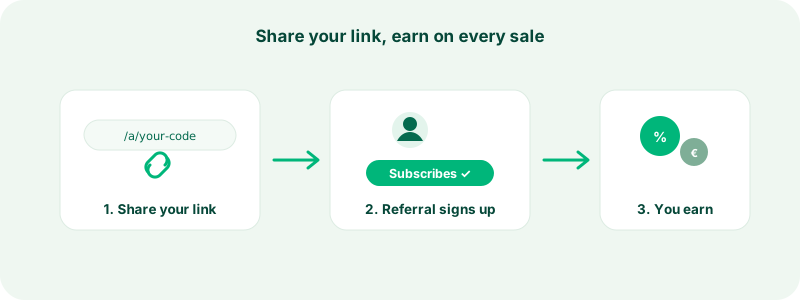
At its core, the program is a simple three-step loop:
- You share your link. After approval you receive a unique referral link tied to your affiliate code. Anyone who clicks it is tracked as your visitor.
- A business signs up. When someone who clicked your link creates a TrustRating account, they are permanently credited to you as a referral.
- You earn when they subscribe. When a company owned by your referral pays for a plan, a commission is recorded for you according to your personal terms.
Commission terms — the percentage you earn on a referral's first sale, the percentage on their recurring payments, how long the recurring window lasts, and any holding periods — are set individually for each affiliate by the TrustRating team. There is no single public rate card. Your exact deal is agreed when you are approved and is always visible at the top of your affiliate dashboard, so you never have to guess what you are earning.
Who the program suits
You do not need to be a professional marketer, but the program works best for people who already talk to businesses about their online presence:
- Agencies and consultants who advise clients on e-commerce, marketing, or customer experience. Recommending a review platform is often part of the job already — the affiliate program simply means that advice is rewarded.
- Content creators and publishers who write about running an online business, comparison articles, software roundups, or tutorials. A referral link in genuinely useful content converts well and violates no rules.
- Existing TrustRating business customers who love the product and get asked about it. If other founders in your network keep asking how you collect reviews, you may as well earn for the introduction.
- Community builders who run newsletters, forums, or groups for entrepreneurs and store owners.
The common thread is a real audience of decision-makers. The application form asks about exactly that, and honest answers matter more than big numbers.
Applying: what the form asks
Applications are submitted from the affiliate program page — the Apply button takes you to the application form. You need a TrustRating account to apply (create one first if needed — see creating your account), and accounts that are suspended cannot apply. The form asks four things:
- Your promotion strategy. How do you actually plan to promote TrustRating? Write a few genuine sentences — the form expects a real answer, not a single word. "I run a newsletter for Shopify store owners and will feature TrustRating in my tooling recommendations" is a strong answer; "social media" alone is not.
- Your channels. Where will your link appear — a blog, a YouTube channel, a newsletter, client proposals, a community you run?
- Your audience. Who follows you or hires you, and why would they care about a review platform?
- Links (optional). URLs to your site, channel, or profiles so the reviewer can see your work first-hand.
Alongside your answers, the reviewing admin sees a snapshot of your actual TrustRating account: how long you have been a member, whether your email is verified, how many published reviews you have written, and whether you own any company profiles. This is why honesty pays. Inflated claims that contradict your visible footprint hurt an application far more than a modest but truthful description helps it. A small, engaged audience described accurately is a perfectly good basis for approval.
You can have one application under review at a time. If you have already applied, wait for a decision before trying again.
The review process
Every application is reviewed by a human on the TrustRating team. Three outcomes are possible:
- Approved. Your affiliate profile is created with your personal commission terms, and your dashboard goes live immediately.
- A follow-up conversation. If the reviewer needs more detail — clarification about your channels, or a discussion about terms — they may open a support conversation with you. You will receive an email with a private thread link where you can reply directly; it works exactly like a normal support ticket.
- Rejected. Not every application fits the program. A rejection is not permanent by default — if your situation changes, you can apply again later with updated answers.
There is no fixed decision timeline, but applications land directly in the admin queue and are typically handled promptly. You will be notified either way.
After approval: your link and dashboard
Once approved, sign in and open your affiliate dashboard from your account console. Everything lives there:
- Your referral link. It looks like
https://yourtrustratingsite/a/your-code— a short link that records the click, sets the attribution cookie, and forwards the visitor to the homepage. A copy button sits right next to it. - Deep linking. You can also append
?ref=your-codeto any TrustRating URL — a specific category page, the pricing page, anywhere — and attribution works the same way. Use whichever fits your content. - Live stats. Clicks, signups, converted customers, and your commission balances update as they happen. You also receive a notification whenever someone signs up through your link or a commission is recorded.
How attribution works
Attribution is deliberately simple and generous. When someone clicks your link, a tracking cookie is stored in their browser. It lasts for a substantial window (currently 60 days from the last click), and last click wins — if a visitor clicks your link after someone else's, you get the credit. The moment that visitor creates a TrustRating account, the referral locks in permanently: they are your referral from then on, regardless of cookies. When a company they own later subscribes to a paid plan, your commission is recorded automatically. The visitor does not need to subscribe on the day they click; they just need to sign up while the cookie is alive.
Program rules
The rules protect the platform's integrity and your fellow affiliates. Breaking them can pause or terminate your affiliate account:
- No self-referrals. You cannot earn commission on your own accounts or subscriptions, and the system actively detects attempts.
- No spam. No unsolicited bulk email, comment spam, or link dumping. Share your link where people have chosen to hear from you.
- No misleading claims. Never invent discounts, guarantees, or features, and never state commission or pricing terms as if they were official TrustRating promises.
- No bidding on brand terms. Running paid search ads against TrustRating's own brand name is not allowed.
Referral patterns are monitored for fraud signals, and suspicious commissions are reviewed by a human before any enforcement — but genuine promotion never has anything to worry about.
Terms and next steps
The full legal terms of the program live in the legal hub — read them before you start promoting. Then share your link, watch the dashboard, and when your first commissions appear, read tracking earnings and payouts to understand how they mature into money in your account. Questions at any point? Contact support — mention that you are an affiliate and include your affiliate code.